DeepSeek's Scaling Law and its implication on GPU demand
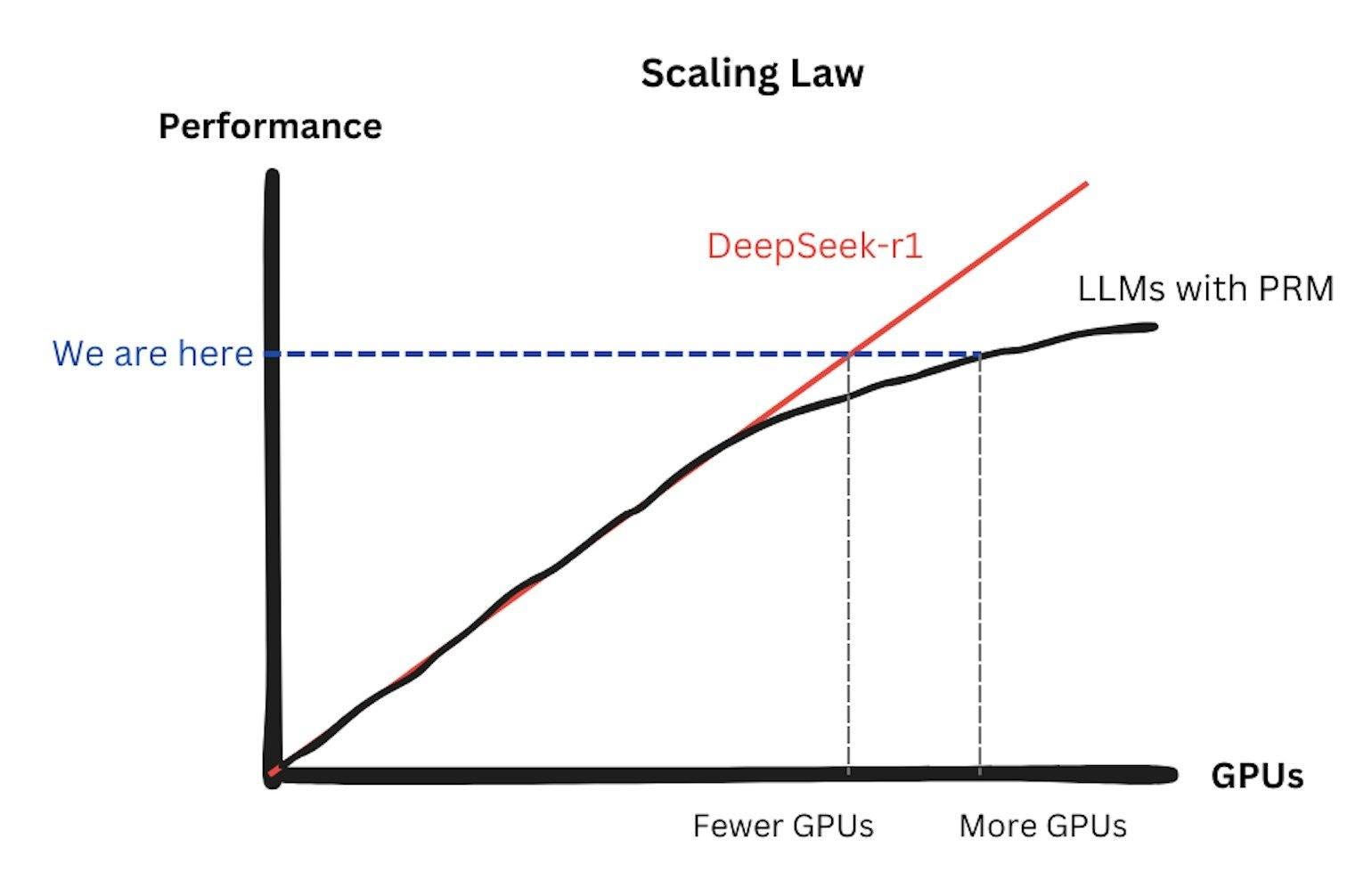
I think a lot of people fail to grasp the full implications of R-1. Let me clarity a few things.
The most popular interpretation is that R-1 shows that you don't need unlimited resources or latest chips to build competitive AI. While this perspective is not incorrect, it doesn't capture the full picture.
In my view, the most critical takeaway from R-1 is that it unveiled a far more efficient scaling law for training reasoning models. This discovery fundamentally changes the game for organizations with significant GPU resources, like Meta and DeepMind, enabling them to scale their already powerful models much faster than before. For those with limited GPU access, however, the relative gap remains unchanged—they’re still playing catch-up.
Crucially, this also means the demand for NVIDIA GPUs is unlikely to decrease. If anything, the new scaling law suggests that GPUs will remain relevant for a LONGER period of time before reaching saturation!
So who are the biggest winners and losers?
Meta, despite reports of internal chaos, could emerge as one of the biggest beneficiaries of this incident. With the R-1 recipe in hand, they could easily release a next-generation reasoning model that not only surpasses o1 but potentially rivals OpenAI’s current best model, o3.
Google Gemini will also be able to take advantage of the R-1 recipe and release a powerful o3 level model very quickly.
In my view, OpenAI might turn out to be the biggest loser in this scenario, assuming they were already aware of the new scaling law, which is very likely from the many vague posts their researcher dropped on Twitter. Their competitive advantage in model performance could be narrowed substantially.
Thanks for reading Felix’s Substack! Subscribe for free to receive new posts and support my work.
Originally published on my Substack on April 18, 2025.